Linear Thinking about Climate Change is a Big Mistake
While analyzing a wide set of systems, it is useful to identify similarities between these systems and generalize them so that these commonalities can be studied in an abstract way. Studying these system-agnostic abstractions allows us to form a set of general properties that applies to all systems that implement these abstractions. These general properties can then be studied in the context of specific phenomena in a way that allows them to be understood more clearly.
A ubiquitous - and abstractable - feature of many systems of change is the linearity or nonlinearity of the behavior of a system. Mathematicians have created a general notion of what it means for something to be linear, and have developed a set of properties that are displayed in all linear systems. The importance of developing an understanding of the linearity or non-linearity of a system cannot be understated for a simple reason: confusing nonlinear systems for linear systems is one of the most egregious misuses of thinking in the entirety of human intellect. Misidentifying such systems frequently encourages poor judgment: people don't save and invest money because they cannot understand the wonder of compound growth, populations do away with small public health measures because they forget that small measures propagate non-linearly and cause have outsized reductions in mortality and spread of disease, and wealthy individuals idiotically risk riches they already have for even more riches they do not need (see the diminishing marginal utility of the dollar).
Developing an understanding of an infinitely complex topic such as climate change may seem impossible. However, rather than focusing on learning more about the systems of carbon emissions, it is useful to simply avoid some of the worst misthinkings about the nature of climate change. Subsequently, avoiding inappropriate linear or nonlinear thinking as it relates to climate change is an easy way to rapidly improve the quality of one’s understanding of carbon emissions. This essay will provide a base for clear thinking about the non-linearity of climate change by first discussing the general notion of linearity and then analyze this notion relative to carbon emissions with the use of simple thought experiments.
Linearity
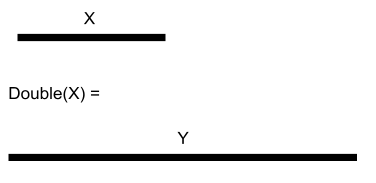
The concept of linearity when it applies to linear change can be understood by imagining the process of doubling the length of a line. Formally, suppose we have some process called Double, which is applied to some line X (use the notation Double(X) to mean apply Double to line X). Double(X) yields some other line Y with the property that the length of Y is twice the length of X. The figure below is a representation of this process:
There are two properties of this process Double(X) that are notable. To imagine the first of these properties, imagine that we introduce a new line called W and add it to X in such a way that the length of X + W is equal to the length of X plus the length of W.
First, apply Double to the new line X + W to get some new line Y.
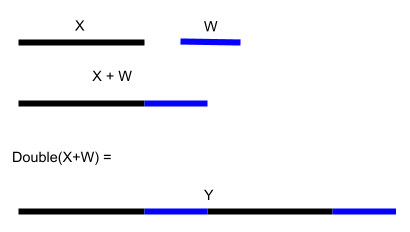
Notice the line Y that is the result of applying Double to X+Y contains two copies of line W and two copies of line X. This means that we can write this resultant line Y not only as Double(X+W) but also as Double(X) + Double (W). So, we can say Double(X+Y) = Double (X) + Double(Y).
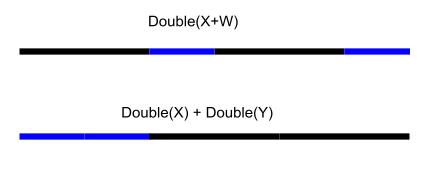
This property of Double happens to be a fundamental property of all processes that are considered linear. More formally, if some process F is linear, it will have the property that F(X+Y) = F(X) + F(Y). Mathematicians call this property additivity.
To grasp the second notable property of Double, imagine tripling the length of line X to get a line 3X, and then applying Double to 3X to get a new line Y. This line Y is six times the length of X, or composed of six copies of X. Since three times two equals six, it is equivalent to say that Y is composed of three copies of Double(X). Therefore, Double(3X) = 3 Double(X).
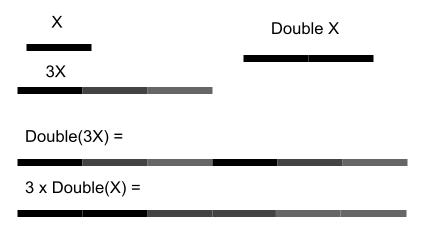
This is not only true for tripling the length of X (multiplication by 3), but is true for multiplication by all numbers. Similar to the property of additivity, this property of Double can be generalized to all linear processes and is a fundamental property of linear systems. Formally, if some process F is linear, then it will have the property that, for some number k, F(kX) = kF(X). This property is called homogeneity.
Additivity and homogeneity are critical properties of linear systems because they are the fundamental properties that define any linear system. A process is linear if and only if it has both the property of additivity and the property of homogeneity. Any process that violates either of these conditions is said to be nonlinear. Showing that a process is linear is as simple as showing that the process obeys these two conditions. Similarly, showing that a process is nonlinear is as simple as showing that the process violates at least one of these conditions.
The Linearity and Nonlinearity of Carbon Emissions.
With a formulation of the fundamental concepts of linearity, the concept of climate change can be reconsidered with respect to additivity and homogeneity. At the core of the many processes of climate change is the process of carbon emissions, or, in other words, natural and anthropogenic activities on earth that map to a specific quantity of greenhouse gas being added to the atmosphere. This process can be viewed as a question: for every unit of greenhouse gas that is released into the atmosphere by some activity on earth, how much greenhouse gas is further added to the atmosphere as a subsequent result of this initial activity. For one to truly get a sense of the nature of the process of carbon emissions, one must consider the linearity of such a process with respect to additivity and homogeneity.
Carbon Emissions and Additivity
Some simple thought experiments show that the above-referenced process of carbon emissions violates the property of additivity. Specifically, the additivity of carbon emissions is sensitive to the time interval over which carbon dioxide is released.
Imagine if humans released a significantly large amount of carbon dioxide at once, and then a few seconds later, released that same amount of carbon dioxide again. In this case, releasing all of this carbon dioxide in two bursts very close in time will have essentially the same effect as if all of that carbon was released at once, because the carbon dioxide has not had time to decay or be consumed by other processes during the one-second gap. Clearly, over uniform intervals of time, the process of carbon emissions is additive, because placing this half of the total carbon through the process of emissions twice over one second has the same effect as placing all of the carbon through the process of emissions once.
Although emissions are generally additive over uniform time intervals, this additivity disappears as the intervals in question diverge. To grasp this concept, imagine that, as a result of photorespiration, a plant emits a single unit of carbon dioxide. Assuming that some other process doesn’t utilize that emitted carbon dioxide, we can assume that the aggregate total carbon dioxide that goes into the atmosphere as a consequence of that plant emitting that carbon dioxide is roughly one unit. This assumption is reasonable because the amount of carbon dioxide emitted by one plant is so small that it won’t reasonably cause any second-order effects that would cause even more carbon dioxide to be released. Say that every year, for a trillion years, that plant emits one unit of carbon dioxide. Because there is such a wide time interval over which the carbon dioxide is incrementally released, it is obvious that this amount of carbon dioxide will never build up in the atmosphere causing significant second-order effects. Therefore, the total amount of carbon dioxide ever to be released by the plant is one trillion units, and the total amount of carbon dioxide to enter the atmosphere as a direct result of the plant's photorespiration is one trillion units.
What happens if instead of releasing these trillion units of carbon dioxide over one trillion years, the plant (by some miracle of nature) releases all of this carbon dioxide at once? Clearly, releasing so much carbon dioxide into the atmosphere at once would cause significant global warming, which causes a number of processes like the melting of ice caps and burning of forests to in turn release more carbon dioxide. In this case, as a result of the plant releasing one trillion units of carbon dioxide at once, far more carbon dioxide than one trillion units is emitted as a direct result of this initial emission. In this case, emitting one unit of carbon dioxide over a trillion years does not yield the same aggregate emissions as releasing one trillion units of carbon at once. Therefore, over divergent time intervals, the additivity of emissions dissipates, showing the non-linear nature of emissions.
Carbon Emissions and Homogeneity
The homogeneity of emissions can also be expressed in a few thought experiments. Unlike the time interval dependence of the additivity of climate change, the homogeneity of climate change is dependent on the amount of emissions.
Consider the previously referenced plant and assume that it emits two units of carbon dioxide. We have already established that such a small amount of carbon dioxide emitted by this plant will have no appreciable second-order effects, so it follows that this plant emitting two units of carbon dioxide has the equivalent effect as if the plant emitted one unit of carbon dioxide, and we (by some magical force) replicated that unit of carbon dioxide and put it into the atmosphere. For small amounts of emissions, the effects of these emissions are clearly homogenous. If, however, this plant were to emit one trillion times this one unit of carbon dioxide(just as it did in the additivity example), this would cause significantly more units of carbon dioxide to accumulate in the atmosphere as a result of this initial emission than the one trillion we would abstain by multiplying one unit of carbon dioxide in the atmosphere by one trillion (replicating it one trillion times). In other words, emitting one trillion units of carbon dioxide results in far more carbon dioxide in the atmosphere than emitting one unit of carbon dioxide, placing it into the atmosphere, and replicating that unit one trillion times. The nature of this simple thought experiment shows that the process of emissions loses its homogeneity - and hence its linearity - as the amount of carbon released increases.
The implication of the interval and weight dependence of the additivity and homogeneity of carbon emissions is simple and problematic: as we emit more carbon dioxide over shorter periods of time, we face significantly accelerating deleterious effects. It is absolutely incorrect to assume the same marginal effect of releasing one gigaton more of carbon dioxide than one unit less and it is therefore crucial that leaders hammer into their mind that carbon emissions do not act linearly. The flip side of this reality is, of course, that every reduction in the amount of emitted carbon dioxide will have non-linear effects on the reduction in deleterious effects, and therefore even small interventions can help. Faced with the effects of such a dire problem, one can now easily grasp why linear thinking is incredibly asinine with respect to the effects of carbon emissions, and our response would be less dulled if we did away with this asininity. Any time that one is faced with a problem of increasing complexity, it would be wise, always, to ask whether it passes or fails the checks of linearity and to think appropriately.